
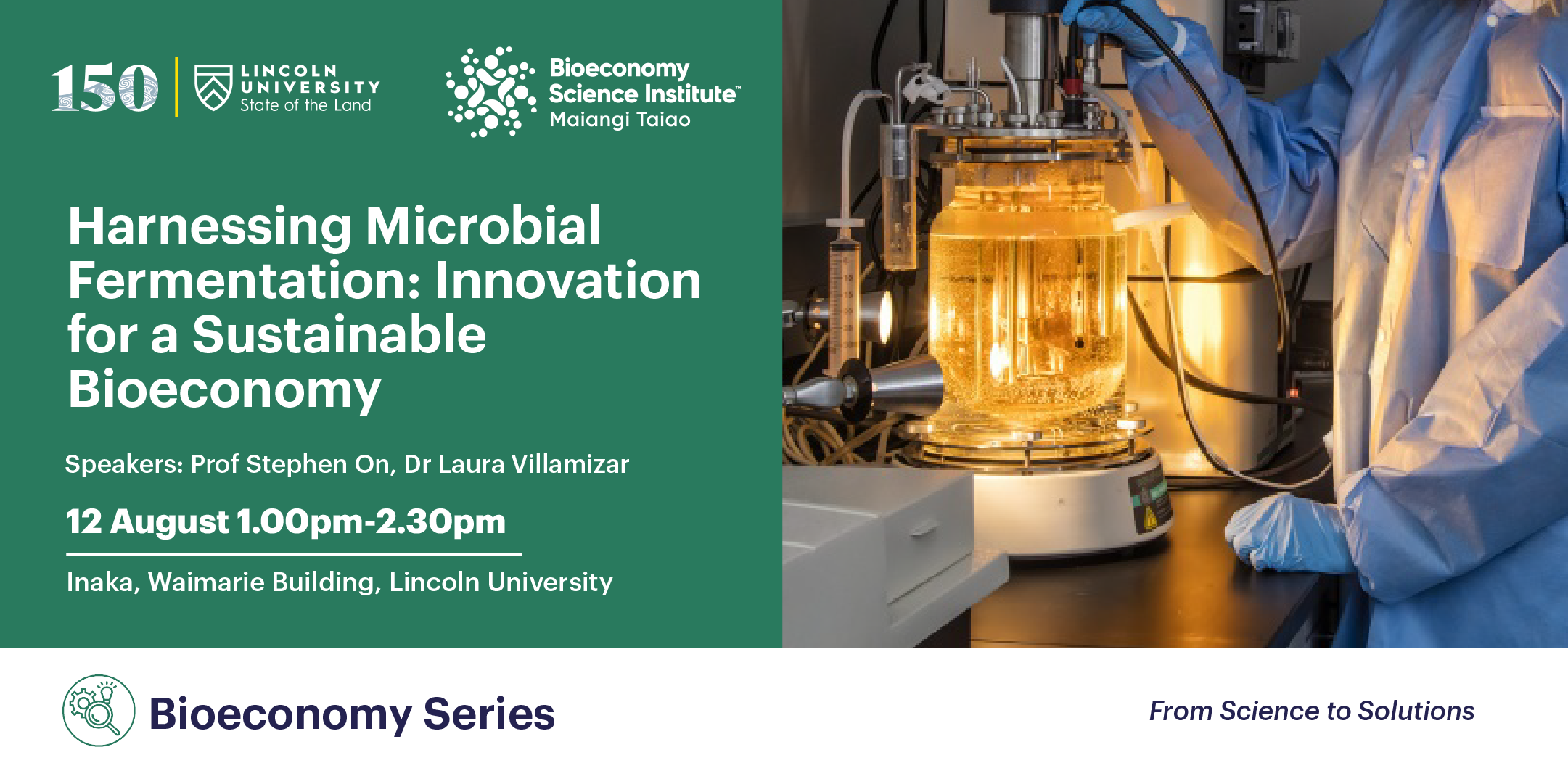
The Bioeconomy Series continues with its next event, exploring the transformative potential of microbial fermentation in land-based systems. Microbial fermentation is a diverse science that sits at the forefront of innovation in food production, bioproducts, and sustainable agriculture, offering pathways to reduce waste, enhance resource efficiency, and create high-value products that support a circular bioeconomy in Aotearoa New Zealand. Understanding and harnessing these microbial processes is central to building resilient, productive, and environmentally responsible land-use systems.
This session will highlight cutting-edge research, practical applications, and emerging opportunities in microbial fermentation. Professor Stephen On from Lincoln University will share insights from his extensive research into microbial processes, including how fermentation can drive new product innovation across the food and beverage sector. Dr Laura Villamizar from Bioeconomy Science Institute will demonstrate fermentation’s value in bioprotection and enhanced plant production. The talks will showcase collaborative projects and applied research, and explore how partnerships between researchers, industry, and Māori enterprises are translating microbial science into real-world bioeconomic solutions.
Join us for an engaging and forward-looking discussion that brings together researchers, students, industry, and policy partners to explore how microbial fermentation can shape the future of sustainable land use. This session offers a unique opportunity to connect, learn, and engage with the science and innovation driving the next phase of the bioeconomy.
Wednesday 12th August
1.00pm-2.30pm
Inaka, Waimarie Building, Lincoln University
Timings
1:00 – 1:10 pm | Welcome and introductions
1:10 – 1:25 pm | Presentation 1 – Prof. Stephen On, Lincoln University
1:25 – 1:40 pm | Presentation 2 – Dr Laura Villamizar, Bioeconomy Science Institute
1:40 – 2:10 pm | Moderated discussion and audience Q&A
2:10 – 2:30 pm | Networking
About Our Speakers

Prof Stephen On, Lincoln University
My research areas encompass microbiological food safety and microbial aspects of winemaking, underpinned by studies in diagnostic methods and bacterial taxonomy. My work aids basic research (e.g., genomics and virulence studies), public health (disease and outbreak diagnostics) and wine improvement (characterisation of winemaking / spoilage microbes). Current research includes: spectral methods for food quality and safety; antibiotic resistance in potentially foodborne pathogens from different agricultural systems; Campylobacter, Arcobacter, Helicobacter and related bacteria; comparative genomics in taxonomic studies; characterization of winemaking yeasts for commercial advantage. My expertise has also been used to inform Government policy and for legal disputes involving contamination of products in the food industry. I have over 30 years of experience in research, have published over 150 peer-reviewed articles and book chapters, and serve on the Executive Board of the International Committee on Systematics of Prokaryotes, and the Executive Committee of the New Zealand Microbiological Society.
Dr. Laura Villamizar, Bioeconomy Science Institute
With 29 years of experience in biological control, microorganism mass production, fermentation, formulation development, and the stabilization of entomopathogenic fungi, bacteria, and baculovirus. Extensive expertise in mycology, including fungal isolation, taxonomy, identification, ecology, characterization, production, and formulation. Wide expertise in design and development of biopesticides and biofertilizers, rigorous efficacy evaluation under laboratory and field conditions, implementation of robust quality control systems, scale-up techniques, and product registration. Strong project portfolio management skills, with proven leadership in strategic planning, governance, and prioritization of research initiatives. My contributions have advanced the commercialization and regulatory approval of innovative microbial products for sustainable agriculture in Colombia, Brazil and New Zealand.
Click here to see more events