
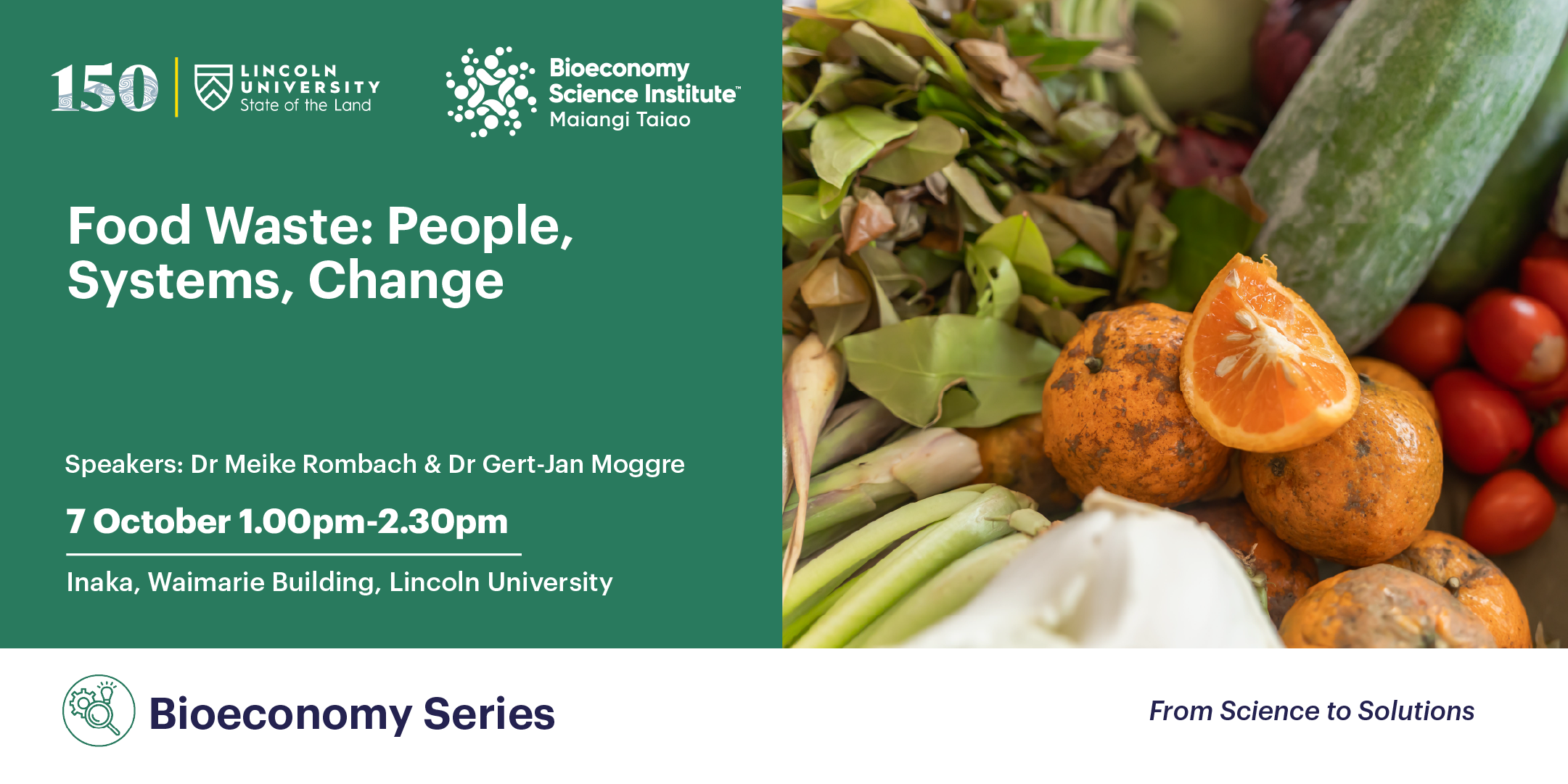
The Bioeconomy Series brings together research, innovation, and real-world application to explore how science is shaping the future of land-based systems in Aotearoa. The series connects students, staff, and partners through informed discussion on emerging opportunities and challenges.
Food waste is a complex challenge that extends far beyond what happens to food at the end of its life. It is shaped by the way food is produced, valued, distributed and consumed, as well as by the behaviours, systems and social movements seeking to create change.
This session explores the social and behavioural dimensions of food waste, considering how communities, consumers, businesses and social movements are challenging established food systems and creating new approaches to reducing waste and building more sustainable food economies.
Dr Meike Rombach (Lincoln University) will explore the social and consumer dimensions of food waste, examining how people understand, value and respond to food waste and the role of social movements in influencing behaviours and driving change across food systems.
Dr Gert-Jan Moggre (Bioeconomy Science Institute) will consider food waste from a bioeconomy perspective, exploring opportunities to rethink waste as a resource and the role of innovation in creating value from food by-products and discarded materials.
Together, the speakers will explore how social change, consumer behaviour and scientific innovation can work together to address food waste. The discussion will consider how changing the way we value food and resources can contribute to more circular, resilient and sustainable food systems.
Join us for an engaging discussion on the social movements, behaviours and innovations shaping how we think about food waste—and how we can turn a growing challenge into an opportunity for a more sustainable bioeconomy.
Wednesday 7th October
1.00pm-2.30pm
Inaka, Waimarie Building, Lincoln University
Timings
1:00 – 1:10 pm | Welcome and introductions
1:10 – 1:25 pm | Presentation 1 – Dr. Meike Rombach, Lincoln University
1:25 – 1:40 pm | Presentation 2 – Dr. Gert-Jan Moggre, Bioeconomy Science Institute
1:40 – 2:10 pm | Moderated discussion and audience Q&A
2:10 – 2:30 pm | Networking
About Our Speakers

Dr. Meike Rombach, Lincoln University
My research is sits at the intersection of horticulture, marketing, and consumer behaviour, bridging the gap between the horticultural sector and the marketplace.I bring horticulture into the consumer world and the consumer perspective into the horticultural world. My research focuses on marketing, consumer, and social issues relevant to New Zealand horticulture, generating insights that are valuable to both academic and industry stakeholders. Ensuring that research outcomes are both academically rigorous and practically relevant is a key priority of my work.
While my research origins are firmly grounded in the horticultural sector, my interests extend beyond this field into a range of related industries and contexts. I particularly value multidisciplinary research collaborations, as they provide opportunities to transfer knowledge, concepts, and best practices across sectors. By applying lessons learned from diverse industries, I aim to develop evidence-based recommendations that support innovation, growth, sustainability, and continuous improvement within New Zealand’s horticultural industry.

Dr. Gert-Jan Moggre, Bioeconomy Science Institute
Gert-Jan’s formal training being as an Organic Chemist. He completed an MSc in carbohydrate synthesis at Victoria University of Wellington in 2012. He then took up a PhD and subsequent post-doctoral fellowship at the University of Canterbury where he was able to integrate his synthetic organic chemistry experience with the strengths of the wider research team in biochemistry. Since 2017 he has worked as a scientist on the Food on the Chemistry and Functionality team within the Food Innovation Portfolio, during which he’s applied himself to the area of plant-based food. His main areas of focus have been on extracting specific plant proteins and carbohydrates to investigate their functionality and applications, as well as studying the impact of fermentation on plant-based foods.
Click here to see more events