
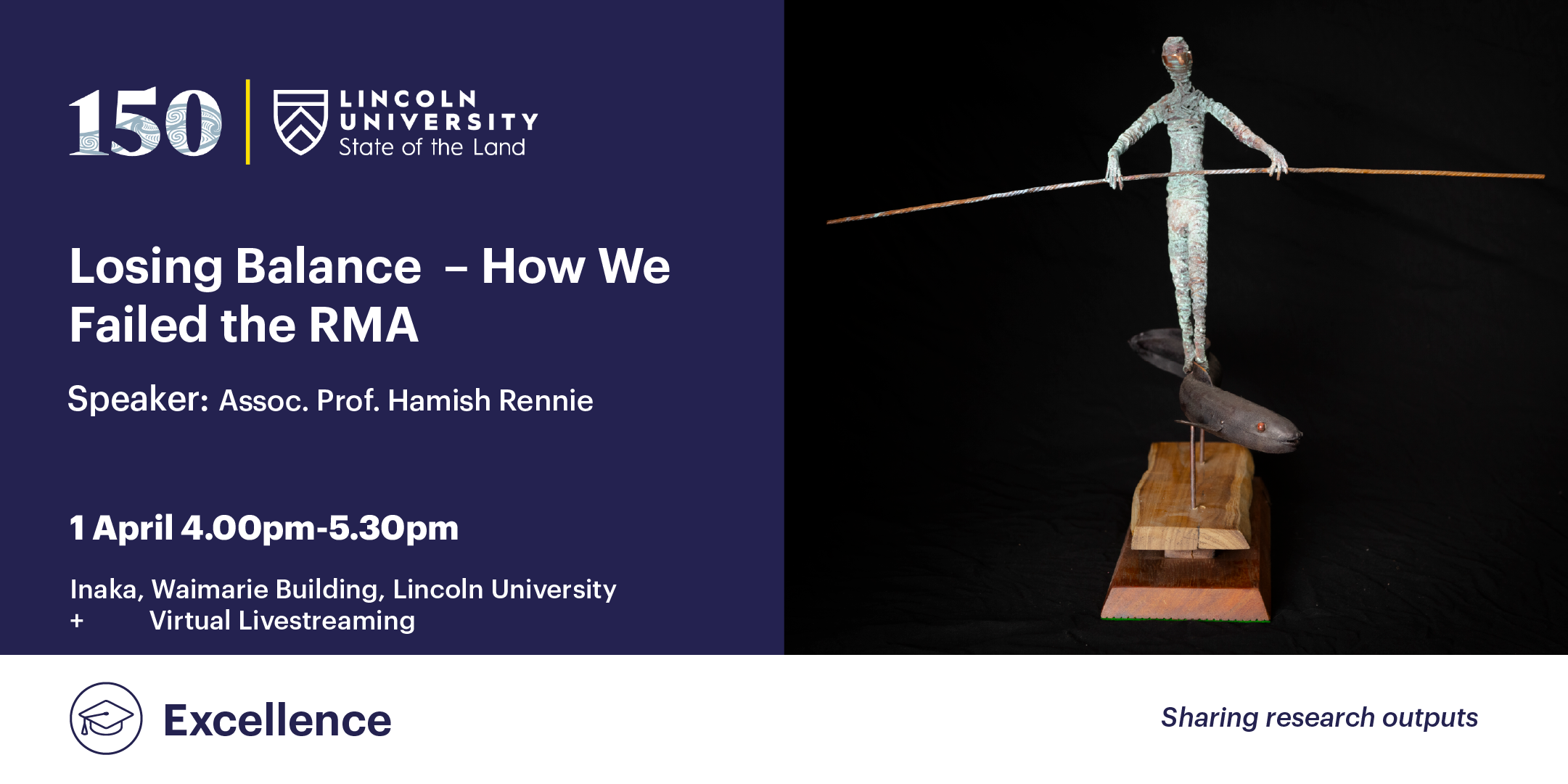
Join us for the next event in Te Whare Wānaka o Aoraki Lincoln University’s Excellence Series, where we showcase outstanding scholarship and real-world research shaping a more sustainable future for Aotearoa New Zealand. This series brings together leading thinkers and practitioners whose work is influencing policy, practice, and public debate, both nationally and internationally.
The Resource Management Act 1991 (RMA) was world leading planning legislation and, despite crippling amendments, arguably still is. A child of neoliberalism it prioritised rights and the market in the planning of land use. Why, then, have both Labour and National-led coalition governments sought to replace it? How and why has it failed? And will the new regime be better?
Dr Hamish Rennie, Associate Professor of Environmental Management and Planning has spent 35 years implementing and researching the RMA. In this presentation he reflects on critical moments in the life of the RMA, the failure of science, inequities and incompetence in practice, the rural/urban divide and the lack of political fortitude. He argues that we, the people, failed the test the RMA posed and we, and our environment, will be worse off as a result.
Be part of this timely and thought-provoking discussion, and contribute to the conversation about the future of environmental governance in Aotearoa New Zealand.
Wednesday 1st April 2026
4.00pm-5.30pm
Inaka, Waimarie Building, Lincoln University
Timings
4.00 pm - Networking
4.15 pm - Welcome & introduction from LU Vice-Chancellor (virtual livestream begins)
4.20 pm - Presentation from Speaker
4.50 pm - Summary
5.00 pm - Networking and questions over drinks and nibbles
5.30pm - Event Ends
About Our Speaker

Assoc. Prof. Hamish Rennie
My research area is geography, environmental planning and management. I apply geographical and planning technical skills and knowledge to environmental problem solving. My primary focus is management of commons (e.g., oceans, freshwater, biodiversity), especially multi-layered commons. Within this I examine how to empower people and establish formal and informal institutions to minimise conflict over resource use and achieve sustainable resilient livelihoods. As a professional planner my focus is on planning as a form of social technology or applied geography and on geography as the source of knowledge on spatial relationships with place. My research and practical experience has helped shape coastal policy and law and led to commissions to assist United Nations’ agencies, regional councils, iwi and community organisations in areas ranging from building resilient tourism to improving the health of Lake Ellesmere/Te Waihora, water, riparian area management and identifying and protecting heritage like natural surf breaks. I love theory and testing it through application in the more-than-human world.
Click here to see more events